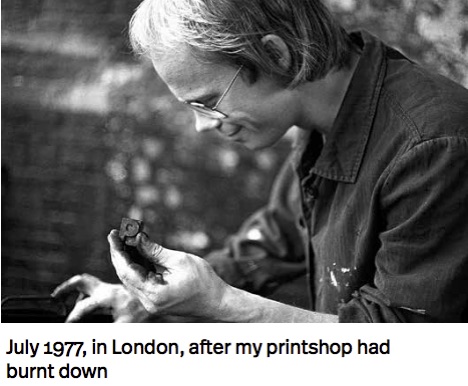
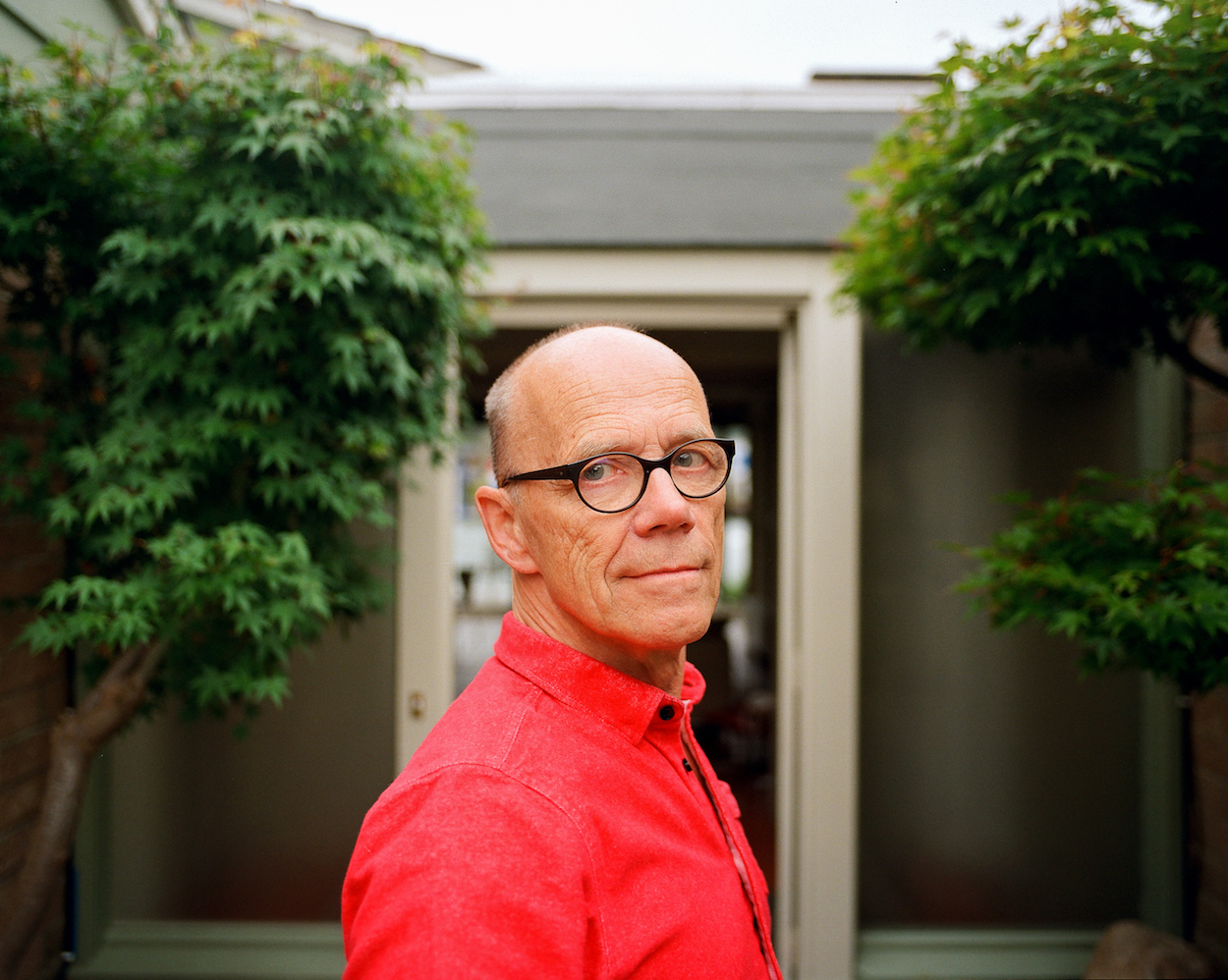
Om Malik: Before we walk down the memory lane, I want to know what you’ve been up to.
Louis Rossetto: And that’s exactly what I’d like to talk about. You did an interview with my good buddy, Erik Spiekermann. Erik and I are publishing my novel, Change Is Good, about the moment in the ’90s when the utopia of the digital revolution was turning into the orgy of the dotcom bubble — in January 1998.
I’ve written a story about six characters, six young people, and their adventures and misadventures in South Park. I wanted to write a story about that period that is probably more real than what you could do if you were writing nonfiction. To try to capture some of the excitement of these pioneers and their mission — to travel west to a new world beyond California called The Future. Erik is publishing the book in Berlin on his own presses using technology he’s developed to reinvent letterpress printing for the turn of the century.
Om: How can we get a copy?
Louis: Appropriately, like we did when we were publishing Wired, it’s not going to be through normal media. I decided I didn’t want to go to New York. I didn’t want to go through normal publishers. I wanted to do what those kids did at the time, which was to go directly out into the world and get direct validation. At the time there wasn’t a way, but there is today — Kickstarter. Kickstarter is a vehicle for finding a market, but also for making a movement. Change is Good is going to come out on Kickstarter, starting the 14th of August, as a limited first edition of 1,000 numbered copies designed by Erik and then printed on his presses.

Om: While you were writing this book, were you doing anything else?
Louis: When I finished with Wired, people came to me and said you should write the story of Wired. I said I don’t want to write the story of Wired. That was just too intense, and in some ways, too hard at the time. I didn’t want to relive that time per se, but I did want to tell the story of that moment that Wired was covering because I think that’s more important.
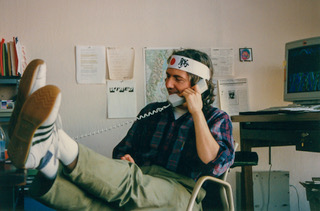 Back in beginning of the 2000s, in the early aughts, I started writing a fictional story set here, literally outside of our windows in South Park. I was at a place where I was ready to go out to the world with it, and then my life got interrupted by the chocolate company.
One minute, I’m a writer working on a story, and the next minute, I’m investing in and the CEO of a chocolate startup, Tcho. For six years, I got sidetracked doing that. I put the manuscript away and didn’t think about it again until I left the chocolate company. I was wondering what I should do next and remembered that I had this manuscript.
Om: How long did it take you to get over Wired?
Louis: I don’t know if I’m over it now. I was officially fired from Wired in 1998, and the company was sold in 1999, and I basically became a civilian involuntarily, but then embraced it wholeheartedly because I had two young kids. At the time, I had the thing that most American men don’t have — the freedom to spend time with my kids. Not quality time, but to be an integral, daily part of their lives. I devoted the next five years to being with them and enjoyed living that life for a while.
Om: The reason I asked is because I had a similar experience, except in my case, the company shut down entirely and at the time it was a really important piece of my life. It still exists, just somebody else owns it. Someone asked me once why I didn’t write about the whole experience, and ironically, I did write about it in a notebook — pen and paper. It was about a hundred pages or so. And I lost the notebook. I think that was God telling me that maybe it’s time for that to go away. But it does stick with you; it frames your way of looking at the world. Maybe your chocolate company was your notebook in many ways.
Louis: Life is funny, because you’re supposed to — well, at least when I was growing up — you were supposed to have this clear idea of the trajectory of your life, a career that you could envision how it’s going to turn out, and the steps that you would take along the way to make that dream real. My life has been about serial obsessions, which I compare to love affairs. You can’t will yourself to fall in love, but suddenly you find yourself in love, and then it becomes something amazing.
My life has been about serial obsessions, which I compare to love affairs. You can’t will yourself to fall in love, but suddenly you find yourself in love, and then it becomes something amazing.
I think people do their best work when they’re obsessed by something they have to work out. That’s been the story of my life. It certainly hasn’t been linear. It’s been about following passions along the way. Sometimes it’s been about being a journalist, or an editor, or an entrepreneur, and other times it’s been about being a father, or a chocolate company guy. Now it’s about being a writer. Each of these have had their own moment; they’ve each absorbed my full being in order to work out whatever it was I had to deal with.

Om: Could I ask you about the world we are living in right now, compared to what it was like at the start of the (tech) revolution, when Wired started? In a way, it captured what was to come. It was the magazine that said, “This is the future; walk on this path and you will get somewhere.” And that somewhere was unknown; every month was a different unknown. Looking back from where we were to where we are now, what do you think? How are you thinking about the revolution now?
 Louis: It’s hard to cast your mind back to 1991 when Jane (Metcalfe) and I moved from Amsterdam to South Park to start Wired. If you look at the statistics, there were one million computers connected to the internet at the time versus 3.75 billion today. It was a zero billion dollar web media market versus a $75 billion market today. It was this empty space that we could fill with any kind of dream.
Meanwhile, it’s also 1992, and we’re just three years after the fall of the Berlin Wall. The cloud that was hanging over the Western world as long as I was alive was suddenly gone. The Cold War and the prospect of instantaneous nuclear oblivion was over. Then you had someone like Francis Fukuyama come along, making his case in The End of History and the Last Man that this time represents the end of history because there’s no counterbalancing power or ideological power to this victorious Western-Liberal-Capitalist-Democracy mob. There will be no more treaty wars, no more Cold Wars, just a future that’s peaceful and prosperous.
In was in this space, this relieved and optimistic head space, that technological developments that had been accruing for the last 20 years — microchips, personal computers, global networks — started to come into fruiton. Arriving in 1992, as naïve as we were, we could see there was a real possibility for using these new tools being created by individuals to impact the world and make change.
Previously, we had been living in an era of mass. Mass market, mass media, mass production — all of which required hierarchy and centralized power and authority. Whereas, with the arrival of personal computers and networks, you could have direct, peer-to-peer, and you could have the power of the computer as your brain appliance actually do stuff that you never could do before. Hierarchies were flattening; people had power to accomplish stuff — and they were. That’s the environment that Wired was trying to represent and describe.

Jane and I had come from Europe, where we had started a magazine called Electric Word. Electric Word was for people who were working in advanced word processing or word-based technologies. I didn’t know anything about word technologies or languages or anything like that. I went into it as a post-graduate student and I discovered all these people working on these supercool things in their little silos. And I said, what happens if we can bring these people together and show them how what they’re doing connects to what other people are doing?
That was Electric Word, and that was the same premise for Wired. It was holding a mirror up to all these people who were creating and using technology in their silos, to say to them, “Hey, look at yourselves. You guys are making cool stuff and you’re having a big impact. Revel in that, but also be aware of that.”
For the rest of the world, Wired was a window into a world that was opaque to them because mass media wasn’t covering it at all. If they were, it was as these weird guys with pen protectors and broken glasses — maladjusted adolescents that were doing stuff out in the world.
Instead, I wanted to say to them, to the people on the outside, that these are the most powerful people on the planet today. They’re not the generals, they’re not the politicians, they’re not the priests and they’re not the pundits. They’re the people who are creating and using this technology to revolutionize everything around us. It was an ambitious idea to put forward at the time, because the media wasn’t giving any indication that this was even happening.
Om: Discovering Wired was like finding my Rolling Stone. With Wired, I found my cultural context more than anything else. I didn’t even think I was a nerd. I wasn’t. I was just interested in the future. And that’s what made Wired so special, was that it said, “Look at where we’re going.” The shiny light was there and I think that’s what excited me about everything.
The internet itself was just so amazing at that time. I discovered the internet in early 1990. The infatuation took about 12 months, and your magazine had something to do with that. I’m grateful for that in many ways. When you look at where the world is today, technology is completely pervasive and mainstream. What do you make of that? Did you imagine this future, or has is it exceeded your expectations?
Louis: I think in the abstract you can imagine anything. But then there’s a reality that you stumble into and it’s never quite the same, and the reality is always more.
I don’t think we could have ever understood fully what that meant. A networked world seemed obvious — it was going to happen. The leverage that computers were going to provide individuals in that network world, that was obvious, too. You could watch the curve of the power computing and the power of networking. A lot of things have come to pass, of course. Lots of people have connected to the network. They have supercomputers in the palm of their hands, which used to fill huge rooms in the Pentagon.
I think there’s a level beyond that; something that we are still grappling with, and may never completely comprehend. It’s like, before there was one or two or three or half a dozen or a dozen representations of reality that were shaped by Pravda and the Kremlin, or shaped by a two-square-mile area in Manhattan. You could go to sleep at night thinking that you had an appreciation for how the world really was, and Walter Cronkite used to end his newscast every evening saying, “And that’s the way it is.” There was this comfort of knowing — believing — that must be the way it is.
Today, with so many different nodes on the network, the idea of “that’s the way it is” seems ludicrous, although people adhere to it in this atavistic way of thinking that there is a “that’s just the way it is” reality. There is a real reality. I think everyone of us are touching the elephant and trying to imagine what that reality is. Instead, what’s happening is nobody can get the whole elephant, so there’s this consensus reality that is being generated about that elephant.

Om: There is the perception, which is reality, and then there is the reality. Reality to each person is essentially how we are interacting with our daily circumstances. I think that’s reality. Everything is perception. I get confused by a lot things I read. I have to stop reading in order to get a better understanding of what is happening.
Louis: When Walter Cronkite was saying, “that’s the way it is,” you felt a certain security. Today, that security is gone because we don’t really know that’s the way it is on an individual level. The whole tribe has a sense of it in their subconscious, a super conscience way. It’s time, perhaps, to let go of the feeling that there is a security of one reality, although there is only one reality. I guess that brings us back to the question: Where have things come since 1992? In that sense, back then, we were approaching a new space and new ideas that were going to change the world.
Now, 25 years later, we live in a changed world that we don’t understand anymore, and that causes discomfort. Things are out of control. That’s what Kevin Kelly was saying in 1994 when he wrote a book, Out of Control, that this technological biological world we’re in is no longer the safe space; it was an illusion that we were believing in during the Cold War. Today’s world is a very chaotic, dynamic space and there’s going to be certain amount of discomfort in occupying it.
Om: Is it because we are in a transition period from the old industrial way of thinking about things to a new way of thinking, one that is more network centric? What does GDP mean in today’s world? As an individual, you’re buying things from Japan and Canada and all sorts of other places. Isn’t that part of trade? We have these old grand notions of everything. I feel that we are going through a big shift that society hasn’t fully understood yet.
Louis: Absolutely. I would argue that in some ways Trump is the beginning of the 21st century. We’ve been lumbering along with stuff that is a throwback to the ’90s. The ’90s ended with the dotcom bubble bursting.
They also ended in lots of ways with 9/11. The 1990s were about a decentralized, non-hierarchical world where decision-making and changes occurring across this membrane. The movement away from hierarchical control was in fact blocked by the 9/11 tragedy, which prompted a return to and embrace of this idea that there is some central power that can control things benevolently. This went on through the Bush era and the Obama era.
The Bush era was about returning power to the State so that it could defend you against the maniacs out there. The Obama era was about, “If we only got control of the power of the State, we could use it to good ends.” The 21st century is about the breakdown of this idea, which had a fake resurgence over the last two presidencies. I think maybe we’re going back towards the idea of, “Wouldn’t it be better if we worked directly to make the change we want to see, instead of trying to subcontract it out to other people to do?”
That was the power of the 1990s. “We’re not going to subcontract this; we’re going to do it ourselves.” “We’re going to change industries directly by making these new tools or organizing things better.” “We’re going to change this; we’re going to change that; we’re going to change how we start a company.” “We have new technology and we are going give this technology to other people.” All of these things were happening because individuals were working with other individuals to actualize ideas they had, rather than believing that somehow we need to do this on a macro level, which is completely impossible.
“We’re not going to subcontract this; we’re going to do it ourselves.” “We’re going to change industries directly by making these new tools or organizing things better.” “We’re going to change this; we’re going to change that; we’re going to change how we start a company.”
Om: What do you think about a lot these days? What’s on your mind?
Louis: People talk about the hockey stick and how we’re moving up the hockey stick. I think a lot of people here in Silicon Valley think that we’ve moved up the hockey stick quite a bit since the ’90s, but I keep saying that the hockey stick keeps moving down — and we’re still only at the beginning of the hockey stick. All of the technology, the networks, the tools have enabled the creation of the data AI and a lot of other things, such as sequencing genes.
We’re only at the beginning of a new hockey stick as a result of those breakthroughs. The new hockey stick is even more amazing than the last one. The changes are going be even more powerful than before. We need to be addressing the possibilities of the future with the same kind of optimism and critical analysis that we did in the ’90s. I think we would be happier and we’d end up making a better world more likely.
Om: I have two takes on this. One, I definitely believe that we’re just beginning to understand the capabilities of the pieces we have built. At the same time, we as an industry, if you want to call it that, have become very mercantile, very driven by the dollar and very little driven by imagination. Even a lot of the new people who are coming in are less driven by the dream and more by the dollar.

How do we get people to think differently about the future? What is it that needs to happen, and how do we shift the focus from dollars?
Louis: I should be asking you that question because you’re the guy with the dollars.
Om: We invest in a lot of those dreams, and that’s what makes me excited about my job, to work with people who are trying to figure out new microbes using data and genomics those who build drone mapping services. I believe in the power of the data and intelligence for better maintenance of our networks, of our machines, of our homes. Why not? So we invest in that future. But I think there is a lot less dreaming going on these days.
Louis: It goes back to this question of attitude, how you perceive the world. I think what I keep coming back to is in the 1990s, the attitude was, the future’s so bright I gotta wear shades. That was literally a song. [Ed.Note: It was a great and fun song, Timbuk3 “The Future’s So Bright, I Gotta Wear Shades” (1986) — though not quite the 1990s.]
We can do anything; anything is possible. We can reinvent the world, every aspect of it. We can make it better with positive change. This optimism is crucial to being an entrepreneur. As an entrepreneur, you can’t not be an optimist. But I think some of the optimism has been lost since then. The was the shock of the bubble bursting, the shock of 9/11, the shock of the financial meltdown in 2008. Then, the intractable war on terrorism, the intractable political issues in the West in general, and the European meltdown as well, which continues.
We live in this Marvel universe where the problems are so large that the planet itself is under attack by alien forces and the only people that can save it are those with superpowers — aka superheroes. But to me, that’s a misrepresentation of the real situation, that the world is getting better. Violence is declining. Lifespans are expanding. Health is better; quality of life is improving. Poverty is decreasing.
Objectively, the indicators are pointing to the fact that things are getting better. Instead, a lot of people are going around angry, frustrated and fearful about a future that they’ve created in their own minds. It isn’t real.
I think approaching the future with optimism is important. If don’t approach the future without optimism, if you don’t think that we can make a better world for your children, then you won’t. You’ll end up in this kind of apres moi le déluge, a catastrophe, let’s indulge ourselves in the moment — as opposed to making this a better world.
I don’t mean, in a Silicon Valley sense, “making a better world” as part of a business plan. If people believed and acted like the relationships they have and the actions they do can directly make things better, the world would get better. I truly believe that. It’s this micro decision-making level of individuals that matters the most. If you treated every other person better than you do now; if you thought about the companies you’re working with, or the products and the ideas you’re working on, as being part of a process and a matrix connected with other people doing that, too; this would have more impact than any specific party capturing the White House, or doing another mammoth supra level event, which isn’t going to result in anything right anyway.
If everybody focused on what they could do, the net result would be even more than what’s happening now, which I think is still pretty good.
Om: What do you read these days in the news and tech media?
Louis: I graze. I don’t really obsess. Again, I think if you look back at when Wired started, there were three national networks, there were a few cable companies. There were still big magazines. Time Magazine had four million copies every issue. Playboy had five million copies. That landscape has changed. I look at the big stuff, I look at the little stuff. I feel like I’m not even close to doing as good a job as I need to, to understand.
The difference between now and then, in some sectors, is that at that time the players were pioneers. Now the players are settlers. The settlers can be doing all sorts of cool things. It’s San Francisco in 1900 versus San Francisco in 1848.
South Park — this park here in front of your office — was built just after the Gold Rush as the first planned community in San Francisco in the 1850s. By the end of the century, all of the settlers coming out here were coming out for something they could see and reference and understand.
 Certainly, it must have been less exciting than those first pioneers who came here wondering, “Am I going to starve, or am I going to find riches?” That is not our world today. Much of what we know has been settled. Yet, there are still frontiers that are being opened. There are old spaces that are interesting. The biological sciences, those areas, I think of all the development that’s happened and still all the development that’s ahead of us. There are numerous spaces there.
Om: I’ve been wondering about something ever since decentralized media came about. I wonder if we will ever have great editors like yourself or Anna Wintour at Vogue?
Louis: Marshall McLuhan was our patron saint, and in Medium Is the Message, he famously wrote about how every medium has its own dynamic — and we’ve seen the emergence of a bunch of new mediums in the past century. Whether it’s been newspapers to radio to television, magazines and books. Now on the web, Twitter, Facebook and Instagram are continuing on. Every time, people believe that it’s the end of history, and the irony is, of course, that it’s not.
The media that we’re immersed in today seems sort of like as far as we can think about how things are going to be. I’m going to guess though that there will be more changes coming as to how we consume, how we connect to the world. I think media has an evolutionary purpose; it’s about doing things to the world. The more successful it is in connecting us to the world, the more it should prosper. Those elements in media that don’t, shouldn’t. I’m guessing that there’s life beyond Twitter and Facebook. There’s always a need for somebody to curate what’s out there.
Om: Talking about what’s not changed is the idea of books. They have survived human history in many ways. Which brings me back to your new book, Change Is Good. Do you think you will write more books?
Louis: It’s hard. Writing long stuff is one thing, and I’ve done that, and people can do that. If you’re writing nonfiction, then you have something that you’re trying to capture that has a basis in reality. You can try to reflect that. You can do it better or worse; I would prefer not. It’s almost external to you.
But a novel on the other hand, I’ve discovered, is something else again. Really what people are paying for is to know you, the inside of you, the inside of your head, the inside of your soul. It’s a different experience than I’ve had in media before.
Being an editor or an entrepreneur putting together a media company, in a way you collect people to represent aspects of what you’re trying to convey. You nudge them, inspire them or browbeat them into something that works to make that expression. You’re shielded. You have designers, you’ve got writers, you’ve got editors and all of the rest who are out there in front of you, doing stuff.
With fiction, it’s the opposite. You’re the one that’s in front of everything. I don’t know if I will or not; it’s been hard. It’ll be interesting to see. It’s a relief in some ways. Yet, it’s scary. I don’t know how people are going to react to it. I can only imagine I’m gonna get shot at, get my arrows as well.
Om: Do you think of yourself as a writer or as an editor? That should answer the question about the book very easily.
Louis: I guess I’m both at this time.
Om: The reason I ask is that, if you’re an editor, you need a medium or a publication or something of that sort. If you’re a writer, you can just write. I often grapple with that question in my head. Am I a reporter or a writer? I think I’m coming to a conclusion that I’m a writer. That’s why I can also ease myself into something which is not the traditional idea of media anymore. I can write my personal blog and be happy about it, and do interviews with folks once in a while.
Louis: The thing about a book, speaking about the medium being a message, is that we live in this world that’s gone down to 140 characters. A lot of people now spend a lot of time writing 140 characters. Little bites, thoughts, perceptions, whatever.
But sometimes, you need to have a longer form to fully express an idea, to fully investigate an idea that can have an impact on people. There’s no better format for doing that than books. A lot of people are going to be out there putting their perceptions into the forms that are available like Facebook, Instagram or Twitter, but there’s still a need to convey big ideas and tell your stories. So books will continue to endure. I think magazines might go away as we know them, except for some specialized ways of using paper, super beautiful magazines.
Om: I suspect books remain as the only text form of consuming information as we go into this world of late voices and such. The next achievements of the world are based on environments. I think most of the verbiage as we know it, which is text and some photographs, goes away and becomes much more visual. It becomes more interactive on a visual plane because I think text and typing is not conducive to the way the human brain works.
Louis: The idea that linear thought stems from books stems from the Gutenberg era. Logic and rationality are an important method of storytelling and conveying ideas, we’re going to need those kind of forms in the future. We can get blase about the mundane, incremental changes that are occurring with ever faster chips or new lasers, or whatever. Still, out there at the lower end of the hockey stick, are these new breakthrough technologies that nobody could have seen five years ago.
I used to joke that there was a “Rossetto’s Law of Media.” The consumption of media is a zero sum game. If you’re on Facebook, you’re not reading The New York Times. If you’re in your VR world, with all these people coming at you with stuff, you’re not on Facebook anymore, either. There will be this ecology, this natural turnover of media, as new ones come along that we haven’t been able to perceive yet.
Photos by Chris Michel, Om Malik. Archival photos courtesy of Louis Rossetto.

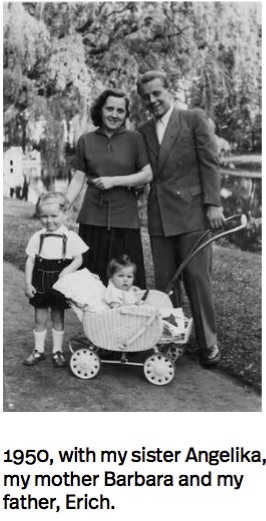 A print shop in the old days had a specific smell. It’s ink, petrol and paper and stuff. That’s one thing that I remember really well, hanging out at that shop and seeing all the machinery. I didn’t know what it was at the time.